
Most gardens in this part of the world have had a difficult few years.
Not dramatically so. There is rarely a single event you can point to. It is more that things which used to be reliable have quietly stopped being reliable. Hydrangeas that wilted by lunchtime and never fully recovered. A hornbeam hedge that browned on one side. Established shrubs – fifteen years in the ground, entirely settled – that went into July looking fine and came out of August looking finished.
When clients ask us what went wrong, they usually expect the answer to be about watering. And this year, watering has genuinely been the constraint: Thames Water’s hosepipe ban has been in force across Oxfordshire and the Cotswolds through the summer. Gardens have gone months without a sprinkler.
But the ban has mostly exposed something that was already true. Far more often, the honest answer is that the plant was never going to cope with that soil under those conditions, and the last few summers had already removed the margin that used to hide the mismatch. Restrictions removed what was left of it.
That is what this piece is about. Not climate change in the abstract, but the question it forces on anyone planting a garden here: given the ground you actually have, what is going to survive the next twenty years?
What is actually changing
The pattern across Oxfordshire and the Cotswolds is not simply hotter. It is more awkward than that.
Summers are running longer and drier, with extended rainless periods rather than an even reduction in rainfall. Winters are warmer and considerably wetter, with more of that rain arriving in bursts. The shoulder seasons have become unpredictable – late frosts after mild Februaries, autumn warmth that keeps growth going far too late.
For a plant, that combination is harder to survive than either extreme alone. A Mediterranean shrub is built for baking summers. It is not built to sit in cold, saturated ground from November to March. A moisture-loving perennial handles a wet winter comfortably, then fails in a six-week drought. Increasingly, our gardens are asking plants to do both.
Which is where soil stops being a background detail.
Why soil is the deciding variable
Soil determines how much water reaches a plant, how long it stays available, and how quickly it goes. Rainfall is what the sky delivers. Soil is what your plants actually receive.
We see this constantly. Two gardens three miles apart, identical weather, completely different outcomes – because one drains in hours and the other holds water for weeks. In a stable climate you could garden reasonably well while ignoring that. You no longer can.
Across our working area there are three broad situations, and knowing which one you are in tells you more about what will thrive than almost anything else.
Cotswold brash
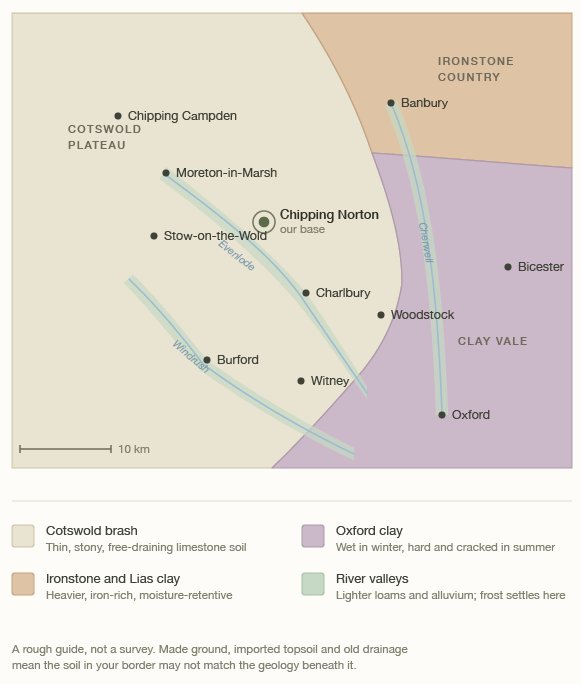
Across much of the high Cotswolds – Chipping Norton, Stow-on-the-Wold, Burford, Moreton-in-Marsh – the soil is brash: a thin, stony, pale layer sitting directly on Jurassic limestone. Often six to twelve inches before you hit rock.
It is alkaline, free-draining to the point of being unforgiving, and it warms quickly in spring. In a wet winter that drainage is an asset. In a dry August it is why a border can go from lush to collapsed in under a fortnight. There is nowhere for water to be held.
Brash is where we see the heaviest summer losses, and where the standard British planting palette disappoints most. Rhododendrons, camellias, most hydrangeas and many birches are fighting the alkalinity and the drought at once. They may survive for years on watering and goodwill, but they are permanently stressed – and stressed plants are the first to go in a hard summer.
What works is planting that evolved on thin, dry, alkaline ground. Deep-rooted, silver-leaved, aromatic, structural. Perovskia, Phlomis, Cistus, Eryngium, Verbascum, Euphorbia characias, bearded iris, Nepeta, Achillea, Santolina, with grasses such as Stipa and Sesleria. For structure, whitebeam, field maple, hornbeam and holm oak all handle this ground far better than the usual choices.
The brash gardens that came through the last few summers well were not the most watered. They were the ones planted correctly in the first place.
Oxford clay and the heavier vales
Drop off the limestone – towards Bicester, the Oxford vale, parts of the Banbury area – and the situation reverses.
Heavy clay holds water tenaciously. In winter it can be genuinely waterlogged, cold and airless, roots effectively standing in water for months. Then it dries, shrinks and cracks, and by late July it is as hard as a path. The same soil doing two opposite things six months apart.
Here is the point most people miss, and we find ourselves explaining it every year: most summer losses on clay are not caused by summer. They are caused by root damage the previous winter. A plant that spent January in saturated ground enters the dry season with a compromised root system and no capacity to reach for moisture. It fails in August, and the drought gets the blame.
This is why Mediterranean planting so rarely succeeds on clay, however hot the summers get. Lavender and Cistus do not die of heat here. They rot.
Clay rewards a different palette: Cornus, Viburnum opulus, shrub roses, Sanguisorba, Persicaria, Eupatorium, Miscanthus, Deschampsia, hardy geraniums and daylilies. For trees, oak, alder, hornbeam and crab apple are all at home.
Clay also responds extremely well to management. Organic matter worked in patiently over several seasons improves winter drainage and summer water-holding at the same time. It is slow, unglamorous work, and it is the single highest-value thing you can do on a clay garden – one of the reasons consistent year-round garden maintenance delivers so much more on heavy ground than occasional intervention.
The river valleys
Along the Evenlode, Windrush and Cherwell, and on the gravel terraces, you find lighter loams and alluvial soils. Often the most forgiving ground in the region, but deceptive – free-draining enough to suffer in drought, low-lying enough to sit wet or flood in a bad winter. Frost settles here too. Worth knowing before you plant anything tender.
Gardening under restrictions
With the hosepipe ban still in force, what you can do is limited but not nothing. Watering cans are permitted, as is stored rainwater from a butt and reused household water. Some exemptions apply – certain business activities and health and safety cases among them – so it is worth checking your own position with Thames Water rather than assuming.
The practical consequence is that every litre now has to be carried. That changes the calculation entirely. Scattered thirsty plants across a large garden become unmanageable; a concentrated group of well-matched ones does not. And it puts mulch, which most people treat as optional, close to the top of the list – a good depth of organic mulch on damp soil will hold more water in a border than most people can realistically carry to it.
Finding out what you have
You do not need laboratory analysis. Three checks tell you most of what matters.
Squeeze it. Take a handful of moist soil and roll it. If it holds a ball and takes a polish, it is clay. If it crumbles and feels gritty with visible stone, it is brash. If it forms a loose ball that breaks apart easily, you are on loam.
Dig a hole. Eighteen inches deep, fill it with water, let it drain, fill it again. If the second fill clears within an hour you are free-draining. If it is still holding after four, you have a winter drainage problem to plan around.
Read the verges. Wild marjoram, scabious, knapweed and cowslips indicate thin alkaline ground. Docks, buttercup, rushes and heavy nettle growth suggest moisture-retentive soil.
Older gardens complicate this considerably. We regularly find that decades of imported topsoil, made-up beds, buried rubble and forgotten drainage mean the soil in a border bears little relation to the geology beneath it. Walled gardens and long-established plots are the hardest to read and the most rewarding to get right, which is where specialist horticultural assessment earns its keep.
Replanting after losses
If you lost plants this year, resist replacing like with like. A gap in a border is a chance to correct a mismatch that was always there.
Start from habitat rather than from the label. A species that evolved on thin, dry, alkaline ground arrives with the root architecture already built in. That one question – where does this plant come from – will steer you better than any hardiness rating.
Plant in autumn where you can, and this year that matters more than usual. Roots establish through the mild, wet months on natural rainfall, meeting their first summer with something to draw on – rather than going in during spring and immediately needing water you may not be permitted to give them. Plant smaller than feels satisfying: we see two-litre shrubs overtake ten-litre ones planted alongside them, every time, because they establish rather than sit. Mulch generously.
When you do water, water deeply and infrequently. Frequent light watering feels responsible, but it trains roots to stay near the surface, producing a plant that cannot help itself the moment you stop – and under a ban, you will stop. One thorough soak beats a daily sprinkle, particularly on brash.
Where losses have been extensive enough that the structure of a border has gone, we would usually replan the space rather than patch it. Planting and garden renovation done once, properly matched to the soil, costs less over ten years than a decade of replacements.
Right plant, right place, properly meant
Right plant, right place has been repeated so often it has worn smooth. But it was never advice about aesthetics. It is advice about survival, and a changing climate has restored its original meaning.
The gardens we look after that have come through the last few years best are not the most intensively managed or the most heavily watered. They are the ones where the planting was matched honestly to the ground it sits in – accepting the limitations of thin brash or heavy clay rather than fighting them season after season.
That is not a compromise. Gardens planted to suit their soil are healthier, need less intervention, and look considerably better in a difficult August. They are also the gardens that have coped best with this summer’s restrictions – not because anyone planned for a hosepipe ban, but because a garden matched to its ground was never depending on the hosepipe in the first place.
If you are planning a replanting, restoring a garden that has suffered, or simply want to know what you are working with, we are always happy to walk a garden and talk it through. Get in touch and we will arrange a visit.
17 Sept 2026